Featured Author: Debbie Slevin
Debbie Slevin's A Good Man explores the complicated space between public heroism and private reality, examining abuse, survival, friendship and the possibility of healing.

A Good Man - When the person everyone admires is not the person you know
What makes someone a hero?
Is it what the world sees, or what happens behind a closed door?
For award-winning essayist, author, theatrical producer, director and teacher Debbie Slevin, those questions became the starting point for A Good Man, a historical fiction novel set against one of the most devastating events in recent American history.
The idea began with a story Debbie heard about a woman whose husband died in the September 11 attacks. To the outside world, she was a grieving widow. Privately, however, she experienced something far more complicated: relief that she was finally free from an abusive husband.
That contradiction stayed with Debbie.
And eventually, it became a novel.
When a Story Opens a Difficult Question
The story Debbie heard raised a question that is uncomfortable precisely because there is no simple answer.
How do we reconcile the person the world believes someone to be with the person who exists inside a private relationship?
Her colleague's friend had lost her husband on 9/11. He had worked in the financial sector, and his death would have appeared to place his wife among those mourning an innocent victim of an unimaginable tragedy.
But behind the public image was another reality.
He had been abusive.
For the woman left behind, grief and freedom existed side by side.
That complexity fascinated Debbie, but it also touched something deeply personal.
She eventually realized that the protagonist's story was giving her a way to explore and work through the domestic violence she had experienced in her own childhood home.
The result is a novel that looks beyond easy definitions of good and bad, hero and villain, victim and survivor.
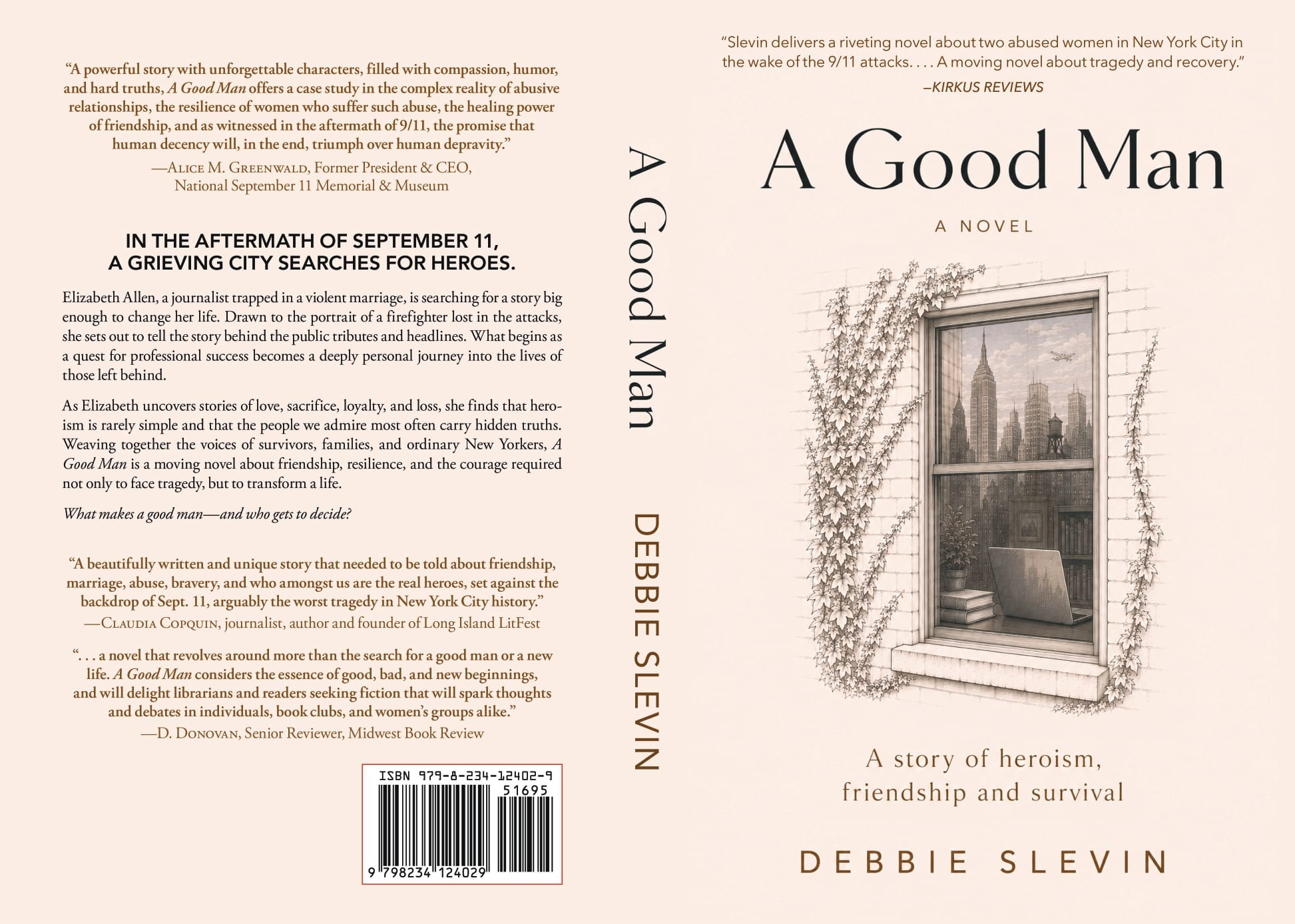
Featured Book: A Good Man
Genre: Historical Fiction
Set against the aftermath and emotional landscape of 9/11, A Good Man explores the complicated realities that can exist beneath public perceptions.
At its heart is a story about abusive relationships, resilience and the ways people survive circumstances that outsiders may never fully understand.
But the novel also explores friendship, compassion and the possibility of healing.
And against the backdrop of a tragedy in which countless people demonstrated extraordinary courage, Debbie asks readers to consider a more complicated question: what makes someone a good man?
About the Book
Review: “On 9/11, faced with unthinkable circumstances, responders and civilians alike acted heroically. Against this backdrop, A Good Man takes an uncompromising look at the multi-faceted qualities of those we celebrate as heroes who, like all people, are not one-dimensional. A powerful story with unforgettable characters, filled with compassion, humor, and hard truths, the book offers a case study in the complex reality of abusive relationships, the resilience of women who suffer such abuse, the healing power of friendship, and as witnessed in the aftermath of 9/11, the promise that human decency will, in the end, triumph over human depravity.” – Alice M. Greenwald, Former President & CEO, National September 11 Memorial & Museum
Looking Beneath the Public Image
One of the most compelling ideas behind A Good Man is the gap between reputation and reality.
People can become symbols in the public imagination. They can be remembered through careers, accomplishments, photographs and the stories others tell about them.
But private relationships can reveal another side entirely.
For someone living with abuse, that discrepancy can be particularly isolating. The person everyone else considers admirable may be the person who causes the greatest harm behind closed doors.
Debbie doesn't approach this subject by reducing her characters to simple categories. Instead, she explores the contradictions that make people human, and the complicated emotional territory survivors may have to navigate when the outside world cannot see what is happening inside.
A Personal Thread Beneath the Fiction
It took Debbie some time to understand just how personal the material was.
Initially, she was drawn to the dilemma she had heard about: a woman grieving the death of her husband while simultaneously feeling relief at being free from him.
As she developed the story, however, she recognized something of her own history within it.
Her protagonist's experience became a way for Debbie to work through the domestic violence she had witnessed and experienced in her childhood home.
That realization adds another layer to the novel.
Writing can sometimes allow us to approach experiences indirectly, to create characters who can enter rooms we once found too difficult to enter ourselves.
Fiction creates distance, but it can also create a different kind of truth.
An Excerpt from A Good Man
I wanted out in the worst way. Not in an ordinary “I’ve had enough of this shit” way, but in a profound, deeply personal way. In a “if I don’t get out soon, I am never going to get out alive” way. And in my mind, for all its education, cultural exposure, and yada, yada, yada, I believed that the only way I was going to get out was to hit it big.
I needed one big idea. One exquisite original thought that I could propel into something large, something sustaining—a vehicle that would be large enough to hold all my proverbial baggage, yet secure and maneuverable enough for me to step into and drive away from here forever.
I thought about this constantly. I imagined just how it might happen. It wasn’t going to be the lottery. I was never that much of a dreamer, nor did I believe that my escape would be handed to me on a silver platter, the only cost a couple of bucks for some computer- generated numbers. I believed I would have to work for it—and probably work very hard (not that I wasn’t working hard already), but when the time came, I wouldn’t have to sneak away. I would pack my things, open that door, and walk out in a grand gesture of accomplishment, defiance, and finality. I would be able to waltz away from this life and this man with financial independence and whatever remained of my self-respect and rather plain, beat-up face.
In the beginning, I used to believe my freedom would come at the cost of some terrible mishap—say, he would fall in front of the subway as it pulled into the station, or some hurried pedestrian would accidentally knock him into the path of a delivery truck. I pictured Fifth Avenue, the block between St. Patrick’s Cathedral and Rockefeller Plaza. Splat. They would have to peel him off the front of a bus, like the Road Runner in a business suit. Or maybe squished between the road and the sidewalk and a couple of taxis. And I would get the call from the hospital—it would come in at the office; I always get the call at my office in this scenario—and I would rush to the emergency room and arrive too late. There would be phone calls. His mother in Forest Hills, too feeble to leave her apartment, and the sister in LA, too vacuous to know she should come. I would be the bereft widow, a sympathetic figure in a black Armani suit. A pants suit, please.
The excerpt immediately establishes a distinctive voice: sharp, darkly humorous and painfully honest.
The fantasy of escape is extreme, even absurd at moments, but underneath the humour is something much more serious … the desperation of someone who feels trapped and cannot yet see a realistic way out.
That tension between humour and hard truth is part of what gives the novel its emotional texture.
A Life Spent Telling Stories
Debbie's creative life extends well beyond the novel.
She is an award-winning essayist and author, but also a theatrical producer, director and teacher. Her theatrical credits include Gate B23: Carry-On Baggage, a best-seller at FringeNYC in 2012; a 2008 New York revival of Songs for a New World; The Last Five Years in East Hampton in 2015; and The Apron Strings Project, produced in Riverhead in 2014 and again in New York City in 2025.
She was also involved with Prospect Theater Company on The Flood, which was covered by The New York Times in 2019. She co-produced this Concert Version through her production company Greymatters Productions and it was presented at the NYTimes theater. There have been other productions of The Flood over the past 20 years.
Her earlier book, UnPregnant Pause: Where Are the Babies?, was published by Figlo Press in New Jersey in 2015.
That theatrical background is interesting in the context of A Good Man. Theatre requires an understanding of character, subtext and what exists beneath what an audience can immediately see.
Those same qualities are central to Debbie's novel.
When Fiction Becomes a Way of Looking Back
A Good Man is ultimately concerned with the stories we tell about people and the stories we don't know.
It asks readers to look more closely at the difference between public reputation and private reality, while also exploring what happens when someone has spent years surviving a relationship that others cannot see clearly.
But Debbie's journey with the book suggests something else, too.
Sometimes we write about a character before we understand why that character matters so much to us.
Only later do we recognize the connection.
Only later do we realize that the story has been asking us to look back.
For Debbie, writing A Good Man became one way of doing exactly that.
Where to Find Debbie Slevin
You can learn more about Debbie Slevin and her writing, theatrical work and other projects through Debbie's website.
A Good Man is available through Amazon.
A Final Thought
The title A Good Man carries a deceptively simple question.
What does it actually mean to be good?
Is goodness measured by reputation, by public acts of heroism, or by the way we treat the people closest to us when nobody else is watching?
Debbie Slevin's novel refuses to make that question comfortable.
Against the extraordinary heroism surrounding 9/11, she looks at the quieter and often hidden realities of domestic life. She writes about abuse and survival, but also friendship, resilience, humour and the possibility of healing.
And perhaps that is what makes the story worth telling.
Because sometimes the most difficult truths are the ones hiding behind the simplest labels.