Featured Author: Uri Marc Nusinow
From Los Angeles to an Israeli kibbutz, Uri Marc Nusinow's memoir follows an unexpected journey through love, reinvention, unlikely careers, and the many twists that shape a life.

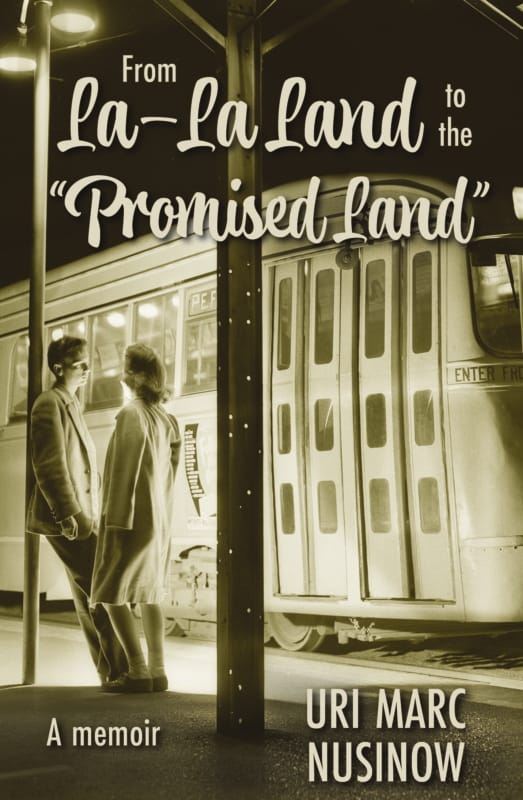
From La-La Land to the “Promised Land”
What do you get when a college dropout from Los Angeles becomes a kibbutznik, museum photographer, chef, project manager, and CFO, and eventually turns that unlikely journey into a memoir?
In Uri Marc Nusinow's case, you get a story that is as unexpected as it is self-aware.
His life has taken him from Los Angeles to Jerusalem and a kibbutz in Israel, through different careers, relationships, marriages, and plenty of twists he could never have planned in advance. He tells that story in From LA-LA Land to the "Promised Land": An Odyssey of Love and Remarkable Careers, a memoir that combines honesty, vulnerability, and a healthy dose of self-deprecating humour.
It is a book about where life takes us and the person we become along the way.
A Memoir That Began With a Conversation
The idea for the book began in December 2018, when Uri's brother Michael came to Israel for a ten-day visit.
The brothers spent hours talking about their parents, Los Angeles, old girlfriends, Israel, careers, divorce, and remarriage. Uri opened a Word document and did what he describes as a “brain dump” of everything they had talked about.
At the time, he had no idea that the document would eventually become the starting point for a memoir.
Two years later, after retiring, Uri returned to that file.
He began to wonder whether his life might actually make an interesting book.
Before starting to write, he read memoirs including Wild, Educated, The Glass Castle, Angela's Ashes, The Liars' Club, and The Color of Water. Then, in early 2022, he began writing his own story.
Dozens of revisions later, From LA-LA Land to the "Promised Land" was self-published on Amazon in June 2025.
A conversation between two brothers had quietly turned into a book.
The Many Lives of One Man
Uri describes himself as a college dropout who has worn many professional hats. His career path is anything but conventional: kibbutznik, museum photographer, chef, project manager, and CFO of the Arava Institute for Environmental Studies are just some of the roles that appear along the way.
But his memoir isn't simply a catalogue of jobs or a record of geographical moves.
Love and relationships are equally important to the story. Uri looks back at the romantic experiences that shaped his self-image and self-esteem, including the encounters that were, by his own description, mostly fruitless.
And he doesn't seem particularly interested in making himself look better in retrospect.
That willingness to laugh at his younger self while still examining the experiences honestly is part of what gives the memoir its distinctive voice.
About the Book
How does Marc —hapless with girls, and a fat college dropout from La-La Land—transform himself into Uri, a slim kibbutznik married to a hot Sabra? And how does that journey lead to a remarkable series of careers?
Well, those are a couple of damn good questions.
From LA-LA Land to the “Promised Land” is the unfiltered story of Uri’s journey from Los Angeles to Jerusalem to a kibbutz, as he finds the love of his life, while zigzagging from museum photographer to chef to CFO of an academic research institute.
He explores with wit and vulnerability his mostly fruitless romantic encounters which shaped his self-image and self-esteem. It is revealing, at times embarrassing, and always told with self-deprecating humor.
The description sets up a transformation that sounds almost too improbable to be true: how does Marc, the overweight college dropout from Los Angeles, become Uri, the kibbutznik?
The Prologue offers us a glimpse.
When the Journey Takes an Unexpected Turn
The opening of Uri's memoir takes us to August 1992, to a singles weekend at the Agamim hotel on the Ashkelon beachfront.
Uri is sipping vodka when two women approach his table.
One is Racheli.
What follows is funny, awkward, flirtatious, and unmistakably human. Uri is immediately intrigued, while simultaneously trying to convince himself that getting involved with a divorced woman with children, and another baby on the way, is probably not what he needs.
Of course, that doesn't stop him from becoming ''already obsessed with her''.
An Excerpt from From LA-LA Land to the “Promised Land”
Prologue—August 1992
I was sipping vodka when two women approached my table. One wore an orange tricot dress stretched tight over an athletic body. The other wore a green shirt and long white pants.
“Can we sit here?” asked Orange Dress.
“Sure, I was saving it for you.”
She grinned.
It was a singles weekend at the Agamim hotel on the Ashkelon beachfront. There were three hundred or so kibbutzniks, either seeking a match or at least a pre-Tinder hook-up. And me? I was ready for anything.
Orange dress said, “What’s your name?”
I stammered, “Uh, Uri … yours?”
“Racheli.”
She elbowed Green Shirt. “Sivan.”
We swapped some initial information.
Racheli said, “I’m from Kibbutz Barkai, divorced for twelve years. My daughter Salit is about to go into the army.”
I said, “I left my ex a year and a half ago. I have four kids … uhm, two girls and two boys. I live on Kibbutz Ketura.”
Racheli nudged Sivan. “I have three teenage kids…I’m divorced, too.”
With her large brown eyes looking straight at me—like she was giving me a test or a maybe a dare—Racheli said, “By the way, I’m adopting a baby girl in a couple of months.”
I thought, yeah, you’re a hottie, but that’s all I need, a fifth kid.
However, I said, “Wow, that’s pretty interesting. Well, maybe I’ll see you at dinner or later at the disco.”
In my room, I pulled on swim trunks, grabbed a towel, and walked to the beach. I sprawled on the sand, closed my eyes, and listened to the crashing waves as I daydreamed about Racheli—the way she danced and how she looked—as if she was luring me.
I was already obsessed with her.
“Morning.”
I opened my eyes. She was standing above me in a skimpy green bikini, staring at my feet.
“Everything okay?” I asked.
“Uhm, sure, it’s just … your feet are so big.”
“Well, you know what big feet means? … Big shoes.”
“I don’t get it.”
“It’s a joke.”
Then she laughed, high and sparkly. I laughed, too. She spread her towel beside me. We talked, we swam, we talked more. She told me about her work with kids; she was a teacher. I told her I was the chef on Ketura. I bought us beers, we drank them, then she lay back and closed her eyes. I snuck glances at her body, a light caramel color, like a butterscotch sundae.
I saw her at check-out in the morning.
“Hey, I enjoyed the weekend. Can I call you sometime?”
She said, “I thought … uhm, maybe I could come to Ketura next weekend.”
Unfuckingbelievable! Like I just won the lottery.
Somehow, I managed to say, “Yes! That’s great … just let me know when the bus arrives so I can meet you on the road.”
The scene is funny, but it also tells us quite a lot about the narrator. Uri is awkward, observant, self-deprecating, and clearly capable of laughing at himself. At the same time, beneath the jokes is a man who is genuinely surprised when something, or someone, he wants seems to want him back.
And that makes the final exchange particularly effective.
He isn't describing the beginning of a grand romance from the comfortable distance of hindsight. We are there with him, at that moment, when he realises that Racheli might actually come to Ketura.
“Unfuckingbelievable! Like I just won the lottery.”
It's a very Uri way of telling the story.
The Courage to Tell the Unpolished Version
Memoirs can be difficult to write because looking back means deciding what to reveal, not only about the remarkable moments, but also about the embarrassing ones.
Uri's approach seems to be to leave the polish behind.
His book explores romantic disappointments, self-image, career changes, divorce, remarriage, and the sometimes unpredictable process of becoming someone different from the person you once were.
There is humour in that process, but also vulnerability.
The result is not a story about having everything figured out. It is a story about figuring things out as life keeps moving.
When a Zigzag Becomes the Story
Uri's career and personal journey might look disconnected when viewed as individual chapters.
Los Angeles. Jerusalem. A kibbutz.
Museum photography. Cooking. Project management.
Financial leadership. Relationships and family.
But memoir has a way of changing how we see those disconnected moments. Once they are placed beside one another, patterns begin to emerge.
The unexpected jobs become part of the same journey. The relationships become part of the same story. The decisions that made little sense at the time begin to show how one version of a person eventually became another.
That is perhaps the most interesting thing about Uri's memoir.
The zigzag isn't something to explain away.
The zigzag is the story.
From LA-LA Land to the “Promised Land”
What began with a conversation with his brother eventually became an exploration of the life Uri had lived and the person he had become.
He didn't set out to write a memoir in 2018. He didn't even realise, until after retirement, that the story sitting inside that old Word document might be worth telling.
But sometimes the stories we need to tell are already there.
They are hiding in old conversations, forgotten memories, awkward encounters, unexpected careers, and the moments when life took a turn we hadn't planned.
Uri Marc Nusinow simply decided to follow those threads.
And somewhere between La-La Land and the “Promised Land”, they became a book.
Where to Find Uri
Readers can find From LA-LA Land to the "Promised Land": An Odyssey of Love and Remarkable Careers on Amazon.
Uri also shares his writing on Substack and his photography on Instagram.
A Final Thought
Not every meaningful life follows a clear direction.
Sometimes we change course because we have to. Sometimes because we want to. And sometimes we simply find ourselves somewhere we never expected to be.
Uri's story reminds us that a life can be made up of seemingly unrelated chapters and still become one coherent story when we look back.
It can be messy. It can be embarrassing. It can be funny.
And it can be worth telling.