When Community Becomes Character
What if tension in a story doesn’t come from explosions or villains, but from the quiet shifts between people? In When Community Becomes Character, Emma Forrester explores how shared rituals, silences, and relationships can carry the deepest emotional weight in storytelling.

💡 Quick Look
• Author of the piece: Emma Forrester
• Topic: How community itself can function as a living character in storytelling
• Main idea: In dystopian or high-stakes fiction, the deepest tension often comes not from explosions or villains, but from the quiet shifts between neighbours — shared witnessing, silences, rituals, and the way trust bends under pressure.
• Key takeaway: Resilience is relational. The heartbeat of the story lies in how a group absorbs threat together.
When I began writing my street as the centre of a dystopian story, I assumed the tension would come from what threatened it. I imagined that the pressure would build through the external danger, through the visible shifts and confrontations that mark a world changing beyond repair. That felt like the natural engine of drama, especially in a genre I have always loved for its scale and urgency.
Yet the first time I wrote a scene in which the entire street witnessed something irreversible together, I found myself lingering not on the event itself, but on what followed. I was sitting at my desk, rereading the chapter, and I realised that the moment which unsettled me most was not the act of violence, but the stillness afterwards. Doors had been open. Windows had been watching. A neighbour had been halfway through a task and had simply stopped. The threat had entered their shared reality all at once, and the air between them seemed altered.
It was in that quiet aftermath that I understood the story was no longer being carried by spectacle alone. The real shift lay in the shared witnessing. Every character now held the same image, the same awareness. Fear was no longer individual. It had settled across the street collectively, moving from front garden to kitchen, from whispered conversation to watchful silence.
Community, in that moment, stopped functioning as background. It began to behave like a living presence.
In much contemporary storytelling, tension is often measured by scale. The larger the explosion, the sharper the betrayal, the more dramatic the confrontation, the higher the stakes appear. But when you centre a community rather than a single hero, tension operates differently. It accumulates through proximity. It grows in the spaces between people who know one another well enough to notice even the smallest shift in posture or tone.
I felt this again later in the manuscript, when a character disclosed a connection to the wider danger pressing against the street. Structurally, it was a clear escalation. The plot tightened. The narrative threads converged. As I continued drafting the scene, however, my attention drifted away from the external figure and toward the room itself. I found myself watching the reactions unfold: who looked away, who stepped closer, who held their breath before speaking.
The revelation mattered, but what stayed with me was its effect on the collective. Guilt did not belong to one person; it entered the space and altered the balance between them all. Doubt did not exist privately; it moved quietly across faces and settled into the group dynamic. The central question shifted from how to survive what lay beyond the gates to whether the trust within them could withstand the strain.
That was when I realised that the antagonist, however necessary, was not the deepest source of narrative pressure. The community’s response carried its own gravity.
Writing community as a character requires a different kind of attention. It asks the writer to notice the domestic rhythms that hold a group together. Who prepares the food? Who organises the rota? Who gathers the children when voices rise? These gestures may appear gentle on the surface, but repetition builds emotional structure. A ritual repeated enough times becomes part of the reader’s expectation, and when it shifts or falters, the tension registers almost instinctively.
If something is always shared and one day it is not, that absence carries weight. If someone who usually speaks grows quiet, that silence feels charged long before it is explained.
Over time, I became increasingly aware that domestic detail was not decorative. It was architectural. The passing of a bowl across a table, the lighting of a fire, the routine checking of gates at dusk, all contributed to the sense that this was not merely a setting but a network of interdependence. Each action reinforced the understanding that no one stood entirely alone, even when fear pressed in.
This perspective feels natural to me because it reflects how I see the world beyond the page. I have always been curious about how people move around one another, how communities form through shared routine and sometimes unravel through silence. Even before I began writing fiction, I was drawn less to spectacle and more to interaction. I wanted to know how people remained human in strained circumstances, how they negotiated loyalty and responsibility, how they gathered when something difficult entered the room.
I tried, early on, to lean more heavily into the dramatic ruptures of dystopia. The explosions, the overt confrontations, the larger external shifts. Yet those scenes, while necessary, never felt like the true centre of the story. The moments that stayed with me were quieter: the shared glance across a table, the unspoken agreement that passes between neighbours, the instinct to stand beside someone when it would be easier to step away.
Silence, too, began to feel different in a community-centred narrative. In isolation, silence can suggest introspection or withholding. Within a group, it becomes collective. When a room falls quiet, the shift is shared. Someone sets down a mug more carefully than usual. A chair leg scrapes slightly across the floor. The tension hums not in a single mind, but across multiple bodies occupying the same space.
As I wrote, my questions changed. I no longer asked only what would happen next. I asked who would see it happen and how that sight would settle into them. I paid attention to the way children moved instinctively toward certain adults, to the way neighbours chose where to stand during difficult conversations, to the unspoken negotiations that occur when survival depends on cooperation.
There is a particular strength in stories that allows tension to emerge through these shared dynamics. In a culture that frequently elevates solitary heroism, writing community as character quietly suggests that resilience is relational. Survival becomes not solely an individual triumph but a collective act of endurance.
The external threat remains important, of course. It provides the catalyst. It presses against the edges of the narrative. But what lingers for me, both as writer and reader, is the way a group absorbs that pressure together. The way trust bends without immediately breaking. The way fear is acknowledged and redistributed rather than carried alone.
When I sit down to write now, I do not begin with catastrophe. I begin with connection. I consider who is standing beside whom, who is watching the road, who is listening for changes in the air while stirring something on the camping hob. The event may come, but the heartbeat of the story lies in how it moves through the street.
Community becomes character not through grand declarations, but through accumulation. Through repeated gestures, shared history, and the quiet decision, made again and again, to remain in relation.
That is where I have found the deepest tension: not in the noise of the explosion, but in the way the street holds afterwards, in the quiet moments when someone checks the gate again before bed, or pauses at a neighbour’s door just to make sure the light is still on.
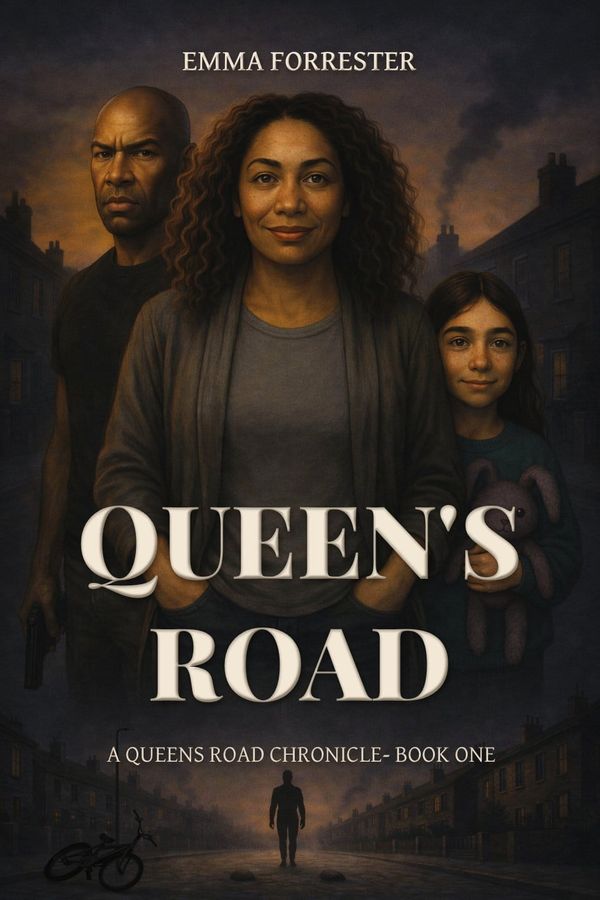
Emma Forrester writes quiet speculative fiction that explores community, resilience, and the emotional landscapes that emerge when ordinary lives are placed under pressure. Her debut novel, Queen’s Road, is a British dystopian story about neighbours learning to survive together when the familiar world shifts overnight. Alongside her fiction, Emma writes reflective pieces on storytelling, observation, and the small domestic details that shape human connection. She lives in Somerset with her family and is currently working on the next book in the Queen’s Road series.
Originally published on Hidden Voices
Indie Life contribution by Emma Forrester
Theme: Community as character in speculative fiction