Featured Author: Nancy Rosenfeld
Nancy Rosenfeld's 50 Cents for a Life brings her father's hidden WWII story into the light: a powerful journey of survival, synchronicity, family, loss, and resilience.

50 Cents for a Life: Giving a Hidden Story Its Voice
Some stories are passed down through generations. Others remain hidden.
For Nancy Rosenfeld, her father's story arrived unexpectedly in the form of a 100-page, manually typed manuscript. It had taken her father decades to put his hidden life into words, and even after he gave the manuscript to his daughters, Nancy wasn't immediately ready to tell the story.
It would take another 35 years.
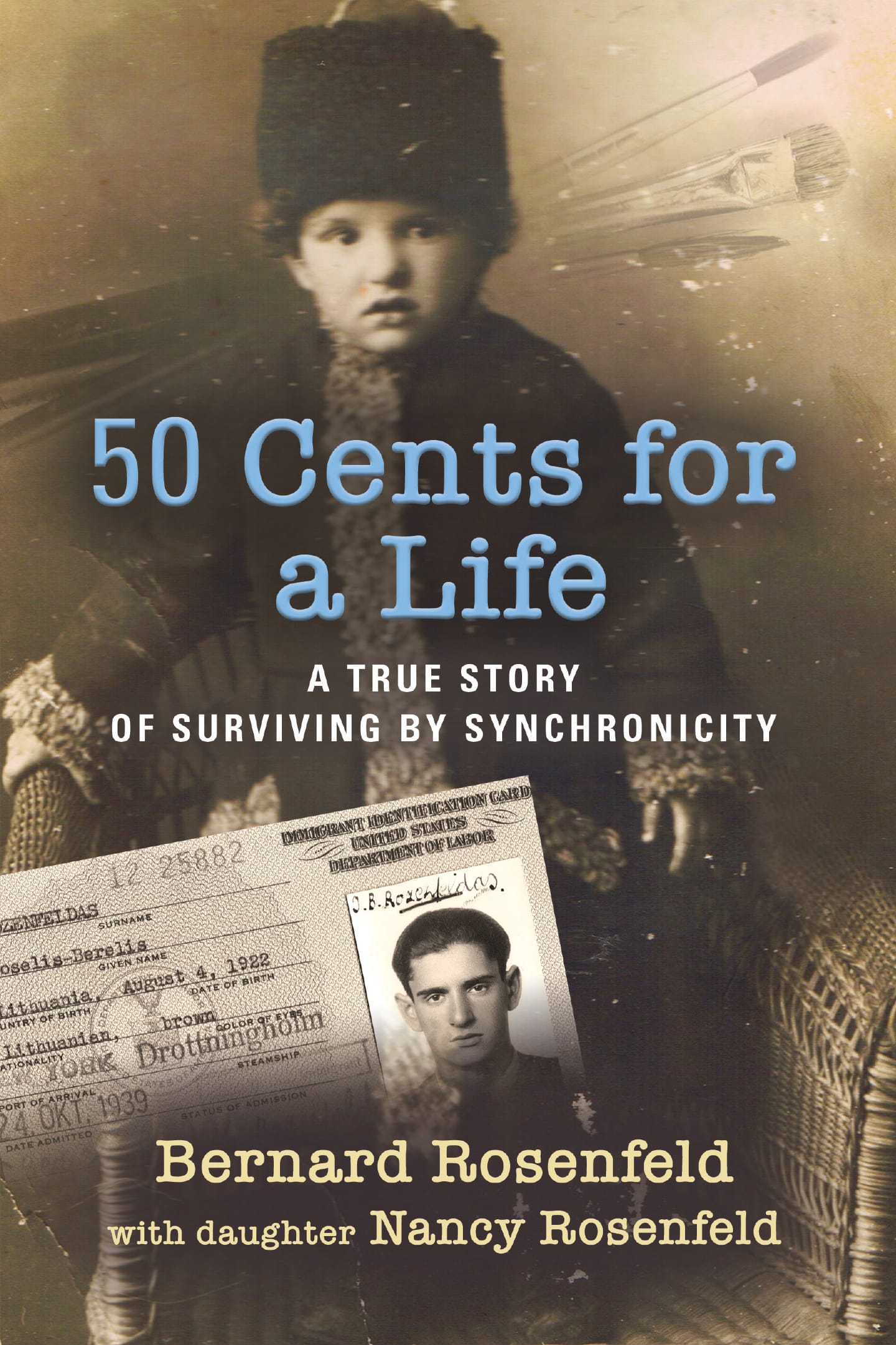
Today, that manuscript has become 50 Cents for a Life: A True Story of Surviving by Synchronicity, a historical memoir and biography about survival, family, loss, resilience, and the extraordinary circumstances that helped one young man escape the devastation of World War II.
At its heart, it is also a daughter's promise to make sure her father's voice, and the voices of those who came before him, would not disappear.
A Story That Waited to Be Told
More than three decades ago, Nancy's father mailed her something she wasn't expecting: the story of his hidden life.
His manuscript was raw, painstakingly detailed, and emotionally charged. It described his escape from Lithuania at 17, the horrific fate of his family during the Holocaust, and the experiences that allowed him not simply to survive, but eventually to build a meaningful life.
He gave Nancy permission to tell his story.
But she wasn't ready.
Thirty-five years later, she was.
What began as an effort to preserve her father's memories became a much deeper journey. Nancy began researching the historical circumstances surrounding his escape, mapping timelines and places and uncovering forces that even her father had never known existed.
The more she discovered, the more extraordinary the story became.
And the more she came to understand the man behind the manuscript.
From Survivor to Storyteller
Nancy is the author of six nonfiction books centred on powerful real-life stories and the possibility of thriving through authenticity.
Her professional life has taken a very different path from traditional authorship. She is a former chief financial officer and strategic planning consultant, as well as a national speaker at conferences, events, and podcasts.
Today, she lives in Maui, Hawaii, where she writes, creates vibrant art, and describes herself as grateful for life in paradise.
But 50 Cents for a Life brought her writing back to a deeply personal place: her family history.
Her father had carried his heritage and values forward despite everything he had endured. For Nancy, his determination to create a meaningful life, while remaining committed to perseverance, compassion, and helping others, became an important part of what she wanted the book to preserve.
The Story Behind 50 Cents for a Life
Nancy describes writing the book as a “soul promise” between herself and her father.
That phrase captures something important about the project. This wasn't a book she set out to write because she had decided to become a commercial author. It came from a different place.
Nancy writes because she feels she has something that needs to be shared, something that might help someone.
Her years as a speaker reinforced that belief. She saw firsthand what happened when people encountered real stories of struggle and resilience: the questions, the reactions, the recognition.
Those stories deserved a life beyond the stage.
Her father's story, in particular, deserved to be heard.
About the Book
For almost half a century, Bernard’s early years of life were locked away hidden from his family and friends.
It was safer that way, being afraid of what might occur if he allowed himself to feel.
He didn’t share his desperate escape from Lithuania at age 17, during perilous World War II, guided by angel-like openings to safety. He veiled the horrific loss of family in the Holocaust and his relentless search for any evidence of their paths.
Hidden beneath a successful, busy life with his American family in the deep South, the silenced heart-wrenching truth finally pierced through his survivor’s guilt, demanding release to heal.
It was time. His secret manuscript belonged with his four adult daughters. Incredible photos and documents accompanied raw words transmitting his story through the darkened eyes of an alone young Jewish man scrambling to survive.
Clearly, something magical safeguarded him. Unexpected synchronicities shielded his exit path where armies stood days before. Newly discovered artistic talents kept him safe and sane. A divine invitation to speak in Washington, DC shed sorrows for astounding connections.
Bernard’s deeply personal story inspires perseverance where paths appear impossible. Within this cathartic and historically informative memoir, synchronicity is the gateway, eclipsed with 50 cents that saved his colourful life.
More Than a Family History
What began as a personal manuscript became something larger as Nancy researched the world surrounding her father's experiences.
The book brings together intimate family history with the historical forces of World War II, exploring not only what happened to Bernard and his family, but the remarkable circumstances that repeatedly opened unexpected paths to safety.
There is also another thread running through the story: art.
Bernard ultimately survived and thrived through his creativity, discovering artistic abilities that became more than an outlet. They became part of the way he remained safe and sane while carrying what he had experienced.
For Nancy, uncovering these dimensions of her father's life meant seeing him not only as her father, but as a young man who had endured circumstances she could only begin to understand through his words and the historical record.
When the Past Becomes a Responsibility
There is something powerful about receiving a story from a parent and knowing that it is now yours to carry.
Nancy could have left the manuscript as a family document. Instead, she chose to investigate it, expand its context, and give it a wider audience.
That decision came with responsibility.
The people whose lives were lost could no longer tell their own stories. Her father had survived, but he had carried much of his past in silence. The manuscript gave him a voice, and Nancy's work gave that voice another life.
It is one of the reasons 50 Cents for a Life feels so closely connected to the idea behind Hidden Voices.
Sometimes giving a voice to a story isn't about discovering something new.
Sometimes it means listening carefully to what has been waiting to be heard.
Survival, Synchronicity, and the Meaning We Find Afterwards
Nancy's book also raises a fascinating question about the moments that shape a life.
Looking back, some events can seem almost impossibly timed: a path opening just before danger arrives, an unexpected connection appearing at exactly the right moment, a talent emerging when it is most needed.
For Bernard, these moments became part of the story of his survival.
For Nancy, researching them decades later became a way of understanding not only how her father survived, but how he managed to build a life beyond survival.
That distinction matters.
50 Cents for a Life isn't only about what happened to Bernard.
It is also about what he did with the life that remained.
Why Nancy Writes
Nancy says she is not a commercial author.
Every book she has written began with the same feeling: I have to share this. It will help someone.
That motivation comes through clearly in the story of 50 Cents for a Life. The book exists because Nancy believed her father's experiences contained something worth passing forward, not only for her family, but for readers who might find courage in his perseverance.
His story began in fear, uncertainty, and unimaginable loss.
But it did not end there.
It became a story of survival, creativity, connection, and the determination to create a meaningful life after everything familiar had been taken away.
Where to Find Nancy
Readers can find 50 Cents for a Life on https://a.co/d/4jLfABg
You can also learn more about Nancy and her writing through her www.50centsforalife.weebly.com
A Final Thought
Some stories arrive when we are ready to hear them.
Others wait for us.
Nancy Rosenfeld received her father's story more than three decades before she could bring herself to tell it. When she finally returned to that manuscript, she didn't simply preserve what he had written. She followed the story beyond its pages, into archives, timelines, places, history, and the remarkable circumstances surrounding his survival.
In doing so, she gave an old manuscript a new life.
And perhaps that is one of the quiet powers of storytelling: sometimes we write because the past asks us to remember. Sometimes we write because someone else's experience might help another person keep going.
And sometimes, after decades of silence, a hidden voice finally gets the chance to be heard.